
Getting Ready for the New Semester:
Designing Clear and Assessable Learning Outcomes
PLO–CLO Design Made Clear
Within the framework of Outcome-Based Education (OBE), learning outcomes function as a strategic foundation for curriculum design, assessment, and instructional planning. Well-formulated Program Learning Outcomes (PLO) and Course Learning Outcomes (CLO) ensure that teaching and learning activities are aligned with the competencies expected of graduates.
One of the most frequent challenges in writing learning outcomes is the tendency to select verbs before clearly defining the intended learning domain. This approach often leads to learning outcomes that are difficult to assess, weakly aligned with PLO, or inconsistent with learning activities.
Learning Domains in PLO–CLO Design
- Cognitive Domain (Knowledge and Intellectual Abilities)
The cognitive domain focuses on students’ intellectual processes, including understanding concepts, applying knowledge, and engaging in higher-order thinking. Learning outcomes in this domain describe how students process information and use knowledge to solve problems or generate new insights. - Psychomotor Domain (Skills and Performance)
The psychomotor domain emphasizes observable skills and the ability to perform tasks, procedures, or operations. Learning outcomes in this domain should reflect students’ competence in executing actions accurately and effectively within a defined context. - Affective Domain (Attitudes, Values, and Professional Behavior)
The affective domain addresses attitudes, values, responsibility, ethics, and professionalism. Although often perceived as abstract, outcomes in this domain must still be formulated in ways that allow observation and assessment through student behavior and participation. Reference to Operational Verbs: Bloom and Fink Verbs

Effective implementation of OBE requires vertical alignment between learning outcomes at different levels:
- PLO (Program Learning Outcomes) describe graduate-level competencies at the program level.
- CLO (Course Learning Outcomes) translate those competencies into course-specific and measurable outcomes.
Each CLO should:
- Contribute explicitly to a single PLO.
- Be formulated according to the appropriate learning domain.
- Be assessable through clearly defined assessment methods.
The ABCD Structure in CLO Formulation
To ensure clarity and assessability, CLO should follow the ABCD structure:

Example of a Well-Formulated CLO
CLO Statement:
Students are able to analyze quantitative research data using SPSS software with a minimum score of 65 based on the assessment rubric.
CLO Component Analysis:

Why This CLO Is Well Formulated:
- The behavior is observable and measurable.
- The condition clearly specifies the assessment context.
- The degree defines a transparent performance standard.
- The CLO is specific to the course and supports relevant PLO.
Assessment Planning in the Syllabus
As part of the preparation for the upcoming semester, lecturers are required to complete the Course Syllabus, including a clear and structured assessment plan. In addition to outlining learning activities, lecturers are expected to calculate and assign the percentage weight of each assessment component used in the course.
The assessment planning process begins by determining the weight of each Course Learning Outcome (CLO) and Sub-Course Learning Outcome (Sub-CLO). Once these weights are defined, lecturers then assign the percentage weight of each assessment method used to evaluate the achievement of each CLO. These percentages will later be recorded in the assessment plan table provided in the Syllabus
To support this process, the assessment mapping and the percentage allocation for each assessment category should be completed using the Microsoft Excel file available at the following link: CLO-PLO Weight Mapping Template
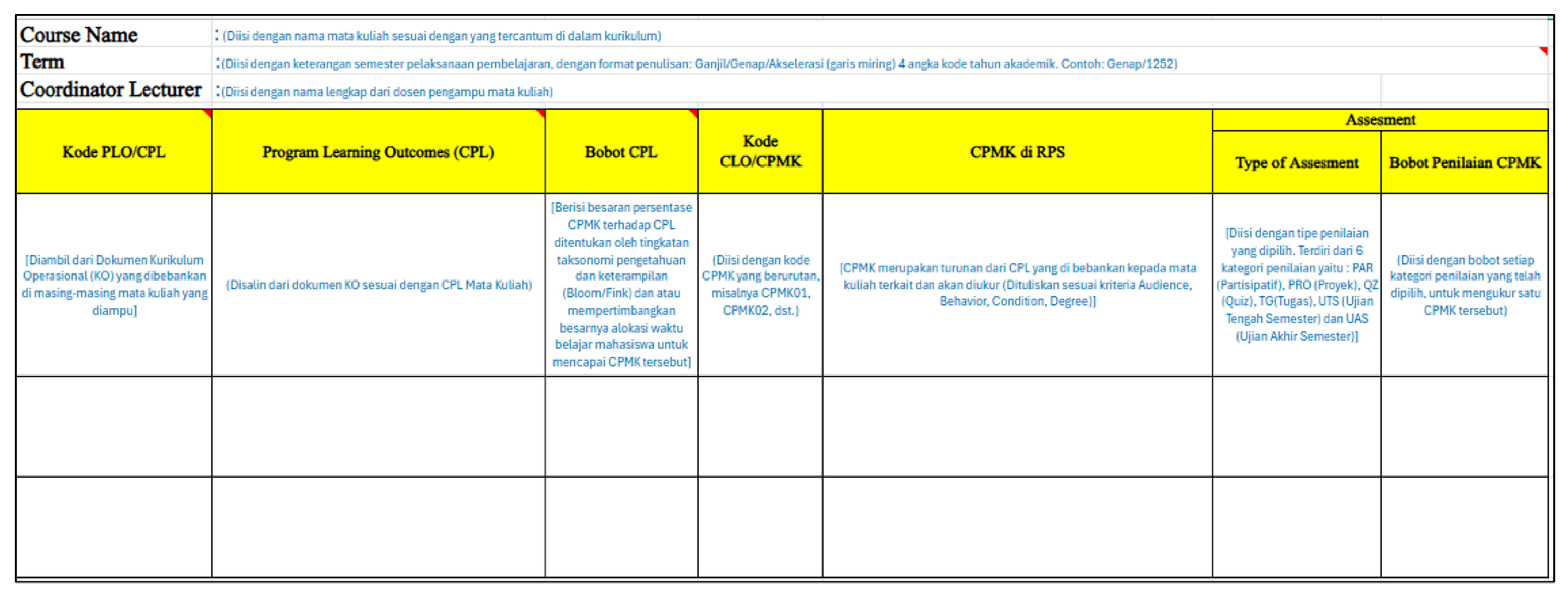
1. Completing the Mapping of Learning Objectives Sheet
a. What to Fill
On the first sheet, titled “Mapping of Learning Objectives,” lecturers are required to complete the course identity, including the course name, term, and coordinator lecturer. After completing this section, lecturers should enter the following information:
- PLO code
- Program Learning Outcomes (PLO)
- PLO weight
- CLO code
- CLO as stated in the Syllabus
- Type of assessment
- CLO assessment weight applied in the course
b. Why It Matters
This sheet serves as the foundation for aligning Program Learning Outcomes (PLO), Course Learning Outcomes (CLO), and assessment methods. A clear and accurate mapping at this stage ensures coherence between learning outcomes and assessment strategies throughout the course.
c. How It Is Used in the Syllabus
The information entered in this sheet forms the basis for the assessment planning section in the Syllabus and supports consistent implementation of outcome-based education across the course. Below is an example of the first sheet (Mapping of Learning Objectives) for reference.
2. Completing the Grading MK Sheet
a. What to Fill
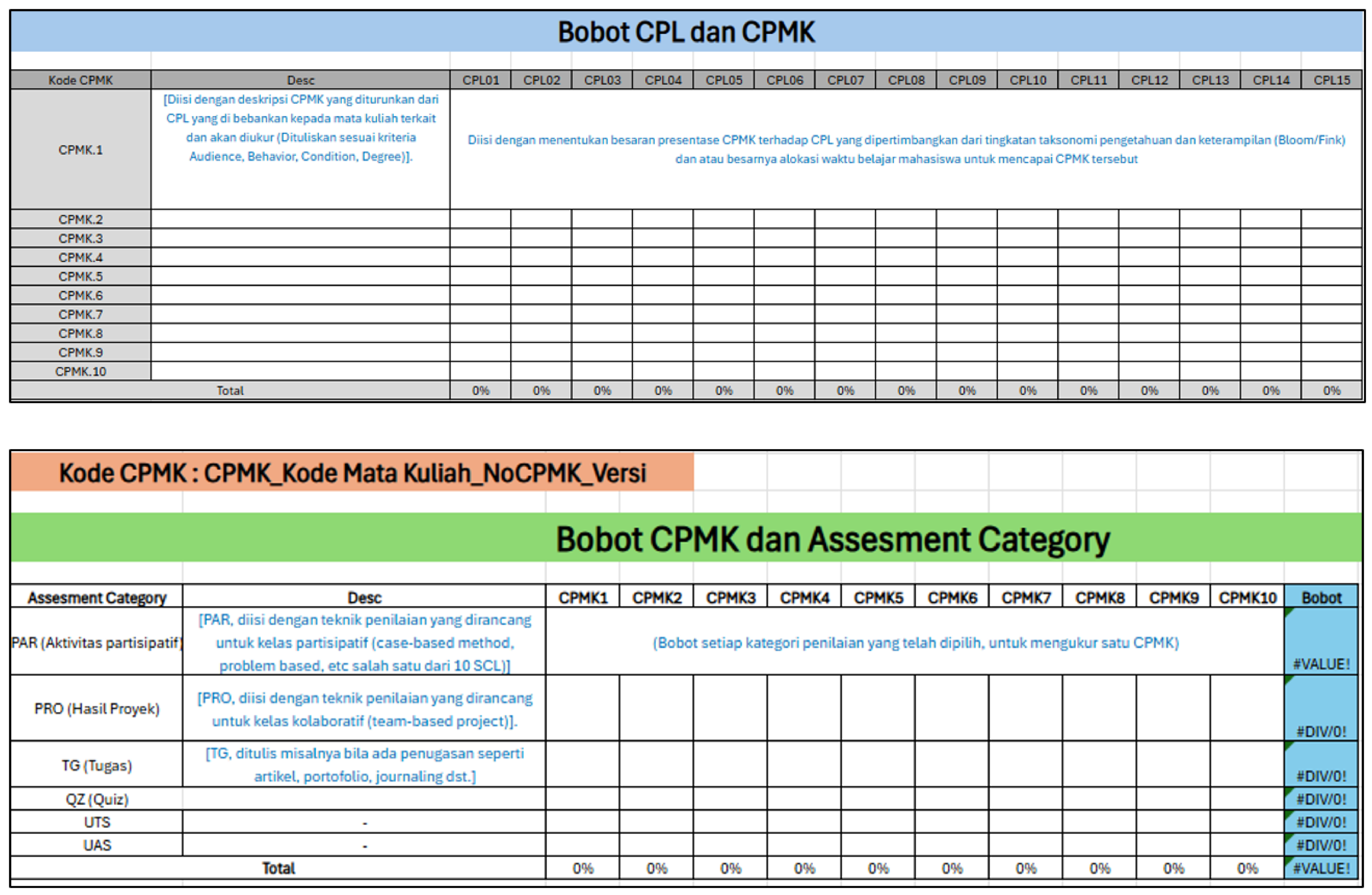
On the second sheet, titled “Grading MK”, lecturers are required to enter the CLO code and CLO description, the weight of each CLO in relation to the PLO, and the weight of each assessment category in relation to the CLO in greater detail.
b. Why It Matters
This step ensures that each assessment category is explicitly linked to the intended learning outcomes and that the contribution of each CLO to the overall course outcomes is clearly defined. Below is an example of the second sheet (Grading MK) for reference.
c. How It Is Used in the Syllabus
The value displayed in the rightmost “Weight” column represents the final assessment weight for each assessment category. This value is used to calculate the final course grade and should be entered into the assessment plan table in the Syllabus.
3. Completing the Sub-CLO Weight Sheet
a. What to Fill
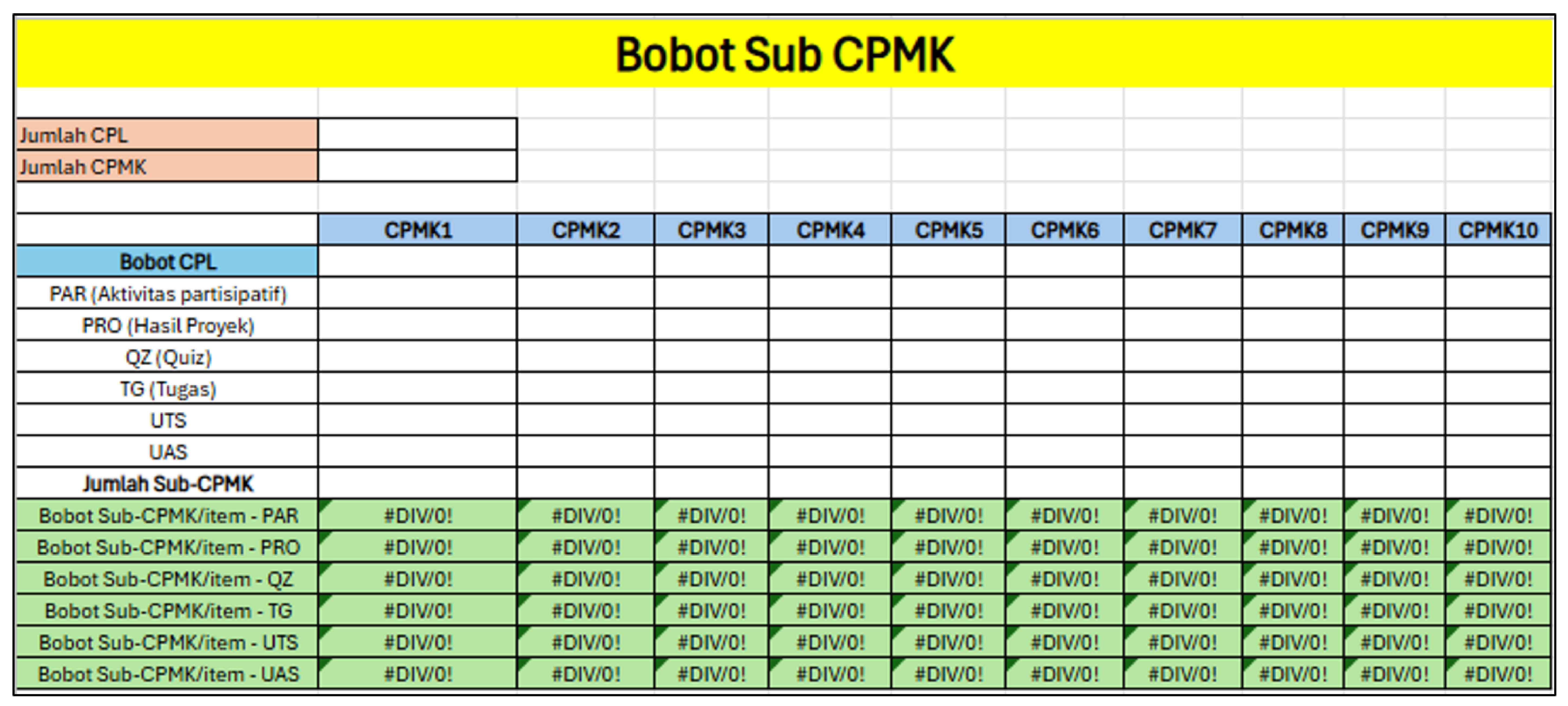
To obtain the Sub- CLO weights, lecturers are required to complete the third sheet, titled “Sub-CLO Weight”. In this sheet, lecturers need to fill in the total number of PLO, the total number of CLO, the weight of CLO in relation to PLO, the weight of CLO in relation to the assessment category, and the number of Sub- CLO for each CLO.
b. Why It Matters
Completing this information allows for a more granular and accurate distribution of assessment weights at the Sub-CLO level, ensuring that learning activities and assessments are proportionally aligned with expected learning outcomes.
c. How It Is Used in the Syllabus
The resulting Sub-CLO weights will be included in the Assessment Mapping component of the Syllabus and serve as a reference for designing assessment instruments and monitoring CLO achievement. Below is an example of the third sheet (Sub-CLO Weight) for reference.
By completing all sections in the Excel template, lecturers will have conducted a detailed and structured assessment weight planning process. This approach supports effective classroom assessment practices and ensures accurate and meaningful evaluation of CPMK achievement.

Next Steps and Support
Lecturers are encouraged to prepare and finalize the syllabus before the new semester begins. A clear syllabus supports effective teaching and assessment and helps students understand learning outcomes and expectations from the start. The finalized syllabus should be shared at the beginning of the semester to help students prepare in advance. If you need further assistance with syllabus preparation or assessment mapping, please contact the Center for Teaching and Learning UPH (edu.tech@uph.edu). Our team is ready to support you as you begin the upcoming semester.