
Designing Transformative Learning
to Build an Impactful University
In an era of rapid technological disruption, higher education institutions are now required to go beyond the mere transfer of knowledge. Through the Impactful Campus movement, universities are directed to become engines of social change and producers of graduates with global competitiveness and strong character. A key driver for this movement is the implementation of transformative learning.
The 5 Core Principles of Transformative Learning
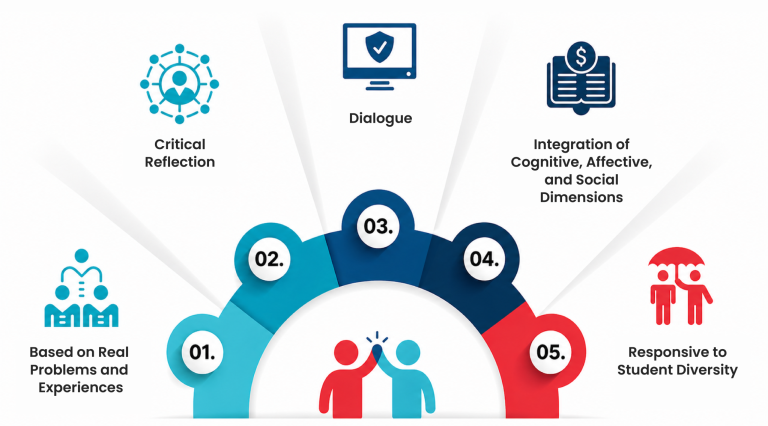
To create a shift in students’ paradigms, transformative learning is built upon five fundamental principles:
- Based on Problems and Real Experience:
Learning begins with complex, real-world situations that challenge students to step beyond their cognitive comfort zones.
- Critical Reflection:
This is the central element where students deeply and rationally re-evaluate their long-held assumptions and beliefs.
- Dialogue:
Creating a social space for students to share experiences and listen to others’ perspectives with an open and empathetic attitude.
- Integration of Cognitive, Affective, and Social Dimensions:
Transformation involves not just the mind, but also feelings and social interactions to form a holistic understanding.
- Responsive to Student Diversity:
Valuing the unique cultural and socio-economic backgrounds of each student as a resource that enriches classroom learning.

The 4 Stages Toward Self-Transformation
The process of student transformation does not happen instantly; it occurs through four systematic core stages:
- Trigger Stage:
Students are faced with an experience that shakes their old perspectives, often referred to as a disorienting dilemma.
- Reflection Stage:
A critical analysis of one’s own values and beliefs to realize the limitations of old ways of thinking.
- Action Stage:
Students begin to apply and test their new perspectives in real-world practices, such as through social projects or simulations.
- Integration Stage:
The new perspective becomes a permanent part of the student’s identity, behavior, and daily habits.
The Role of Lecturers in an Impactful University
Within the Impactful Campus ecosystem, the role of the lecturer has undergone a fundamental shift. Lecturers are no longer just the primary source of information; they have transitioned into facilitators of transformation.
The lecturer’s duty is to design meaningful learning experiences, create psychologically safe spaces for dialogue, and assist students in managing the emotions that arise during the cognitive disorientation process. Furthermore, in the era of artificial intelligence, lecturers serve as guides for reflection, ensuring that students remain critical when using technology as a tool rather than a replacement for thinking. By becoming reflective and dialogic facilitators, lecturers help transform the university’s academic culture into one that is more humanistic and inclusive, ultimately delivering a real impact to the broader community
Chaeruman, U., Hartoto, Arifin, S., Ubaidah, Khafidoh, N., Wikansari, P., Alfian, R., & Susanti, E. (2025). Pembelajaran transformatif di perguruan tinggi.
Jakarta: Kementerian Pendidikan Tinggi, Sains, dan Teknologi.