
Integration of SDGs into the Curriculum & Course Learning Plans to Support Higher Education IKU 7
Dear Lecturers and Students, in today’s rapidly changing global landscape and fast advancing technology, higher education institutions now carry a responsibility far greater than simply producing job ready graduates. We are challenged to shape a generation that possesses not only academic excellence, but also social and ecological awareness to address future challenges. Therefore, in this edition, CTL raises the major theme of the Sustainable Development Goals (SDGs). Let us explore together what the SDGs are, why they serve as an important compass for our university, and how we can apply them concretely in the teaching and learning process as well as in everyday student activities.
Understanding SDGs in the Context of Higher Education
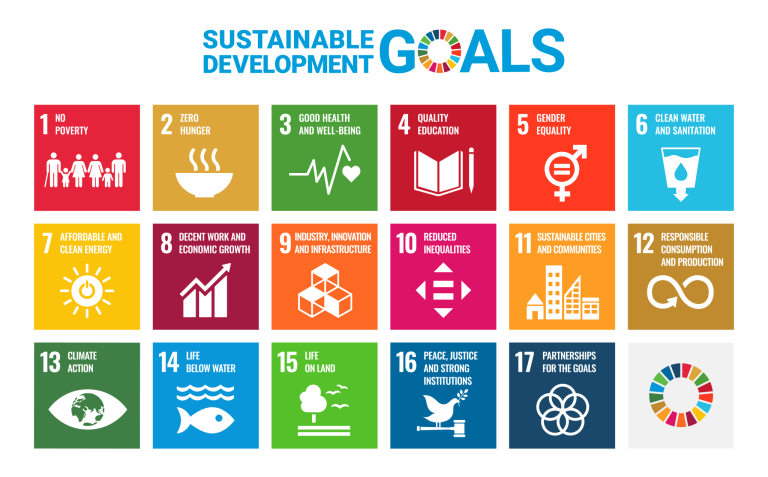
The Sustainable Development Goals (SDGs) are 17 global agendas initiated by the United Nations with achievement targets set for 2030. Their main objectives are to end poverty, protect the planet, and ensure that all people enjoy peace and prosperity. The SDGs are built upon three main pillars:
- Economic Development
Inclusive growth, employment opportunities, and innovation. - Social Development
Education, health, equality, and justice. - Environmental Sustainability
Climate, ecosystems, and natural resources.
Why Do Universities Play an Important Role?
Universities are not merely “ivory towers” where knowledge is stored, but living laboratories. Through curriculum development, research, and community engagement, we have the power to create real solutions based on science and data
to help achieve all 17 SDG targets.

The Relevance of SDGs for Higher Education
IKU 7 on the “Percentage of Higher Education Institutions’ Involvement in the SDGs” positions universities not only as teaching institutions, but also as strategic actors in sustainable development. Based on the IKU Diktisaintek document, this indicator measures the proportion of university programs, activities, research, community engagement, partnerships, or initiatives that directly contribute to the SDGs. SDG 1, SDG 4, and SDG 17 are mandatory, along with two additional SDGs selected according to the university’s strengths, specialization, or strategic context.
Recognized outcomes include education, research, community engagement (the Tri Dharma of Higher Education), partnerships, and institutional initiatives. In the educational aspect, this may take the form of curricula, courses, modules, or literacy programs integrated with the SDGs.
a. Education and Teaching
Curricula that integrate sustainability values will produce graduates who are aware of and capable of contributing to the achievement of the SDGs. Lecturers can design problem based learning that raises SDG related issues as real world contexts, integrate sustainability case studies into existing courses, encourage the ethical and responsible use of AI for self assessment, or design projects based on real problems within society.
b. Research and Development
University research can directly address SDG challenges, ranging from green technology innovation and social policy studies to climate change solutions. Scientific publications and knowledge transfer are tangible contributions of higher education institutions. Universities can direct lecturers’ research topics or students’ theses toward solving local problems, while collaborating with industries, SMEs, or local communities to design environmentally friendly technologies or literacy policies.
c. Community Engagement
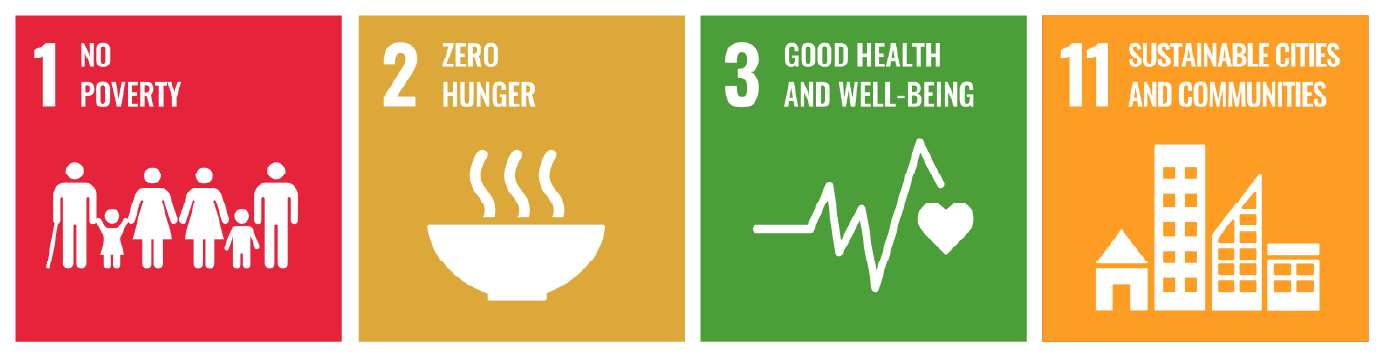
Programs such as KKN, PKM, and industry community partnerships position students and lecturers as agents of change who directly engage with issues of poverty, health, and community empowerment.
Concrete Steps for Integrating SDGs into the Curriculum
1. Determining Priority SDGs at the Institutional and Study Program Levels
Higher education institutions need to establish the mandatory SDGs, namely SDG 1, SDG 4, and SDG 17, along with two additional SDGs selected based on the institution’s strengths. For example:
- Faculty of Computer Science: SDG 9 and SDG 11
- Faculty of Education: SDG 5 and SDG 10
- Faculty of Economics and Business: SDG 8 and SDG 12
- Faculty of Medicine or Health Sciences: SDG 3 and SDG 6
- Faculty of Engineering: SDG 7, SDG 9, or SDG 13
The determination of selected SDGs should be documented in official institutional documents such as strategic plans, curriculum documents, annual performance reports, or internal quality assurance documents (SPMI). This is important because IKU 7 requires that the selected SDGs align with the university’s strengths, specialization, or strategic context.
2. Mapping Courses Based on the SDGs
Study programs need to conduct an initial mapping of all courses. The purpose is to identify which courses already support, do not yet support, or have the potential to support the SDGs.
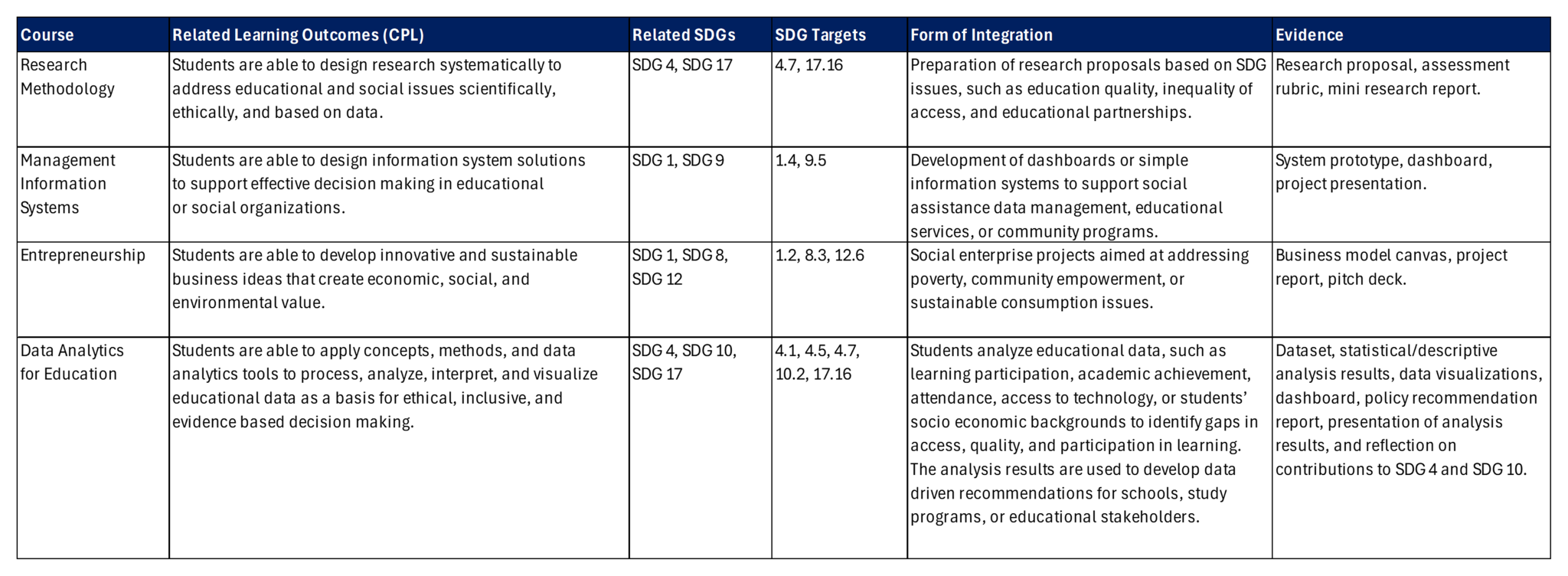
This audit is important because recent studies on the implementation of SDGs in university syllabi show that SDG integration needs to be analyzed through competencies, learning outcomes, and syllabus or course learning plan (RPS) documents, rather than solely through general institutional claims.
3. Linking SDGs with Graduate Profiles and Learning Outcomes (CPL)
Each study program needs to address the following questions:
- What sustainability issues will graduates of this program contribute to solving?
- What competencies are needed for graduates to provide solutions?
- Which SDGs are most relevant to the field of study and future profession of the graduates?
- Which courses are most appropriate for developing these competencies?
Example of a graduate profile statement: “Graduates are able to design data and technology based solutions to support the improvement of educational quality, reduce inequalities in access, and strengthen cross sector partnerships.”.
This profile can then be translated into learning outcomes (CPL), such as: “Students are able to apply data analytics concepts, methods, and tools to process, analyze, interpret, and visualize educational data as a basis for ethical, inclusive, and evidence based decision making.”.
4. Translating Learning Outcomes (CPL) into SDG Based CPMK and Sub CPMK
The integration of SDGs should be clearly reflected in the Course Learning Outcomes (CPMK).
Example Course: Data Analytics for Education
- CPMK before SDG Integration: Students are able to analyze educational data using statistical techniques and data visualization methods.
- CPMK after SDG Integration: Students are able to analyze educational data to identify gaps in access, quality, and learning participation, as well as develop data based recommendations that support SDG 4 and SDG 10.
Sub CPMK can be made more operational, such as:
- Students are able to explain SDG 4 indicators relevant to educational quality.
- Students are able to clean and analyze educational datasets.
- Students are able to create simple dashboards on inequalities in access to education.
- Students are able to formulate data based policy recommendations for stakeholders.
In this way, the SDGs become not only a discussion theme, but are also integrated into learning outcomes, learning activities, and assessment processes.
Integration of SDGs
into Course Learning Plans (RPS)
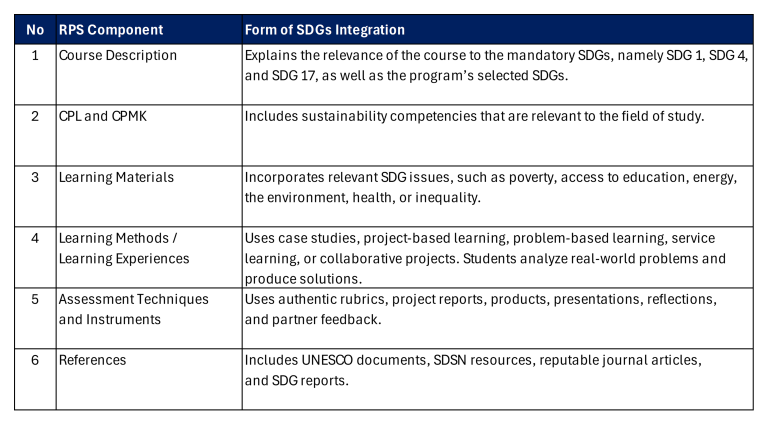
The Course Learning Plan (RPS) should incorporate SDGs into several key components. Evidence of IKU 7 integration, “Percentage of Higher Education Institutions’ Involvement in the SDGs,” that can be attached as supporting data includes course learning plans (RPS), modules, project reports, activity documentation, MoUs or partnership agreements (PKS), student products, publications, or community engagement reports.
Albareda-Tiana, S., Vidal-Raméntol, S., & Fernández-Morilla, M. “Implementing the sustainable development goals at university level.”
International Journal of Sustainability in Higher Education, 19(3), 473–497, 2018. DOI: 10.1108/IJSHE-05-2017-0069.
Brundiers, K., Barth, M., Cebrián, G., et al. “Key competencies in sustainability in higher education—toward an agreed-upon reference framework.” Sustainability Science, 16, 13–29, 2021. DOI: 10.1007/s11625-020-00838-2.
Guo, P., Saab, N., Post, L. S., & Admiraal, W. “A review of project-based learning in higher education: Student outcomes and measures.” International Journal of Educational Research, 102, 101586, 2020. DOI: 10.1016/j.ijer.2020.101586.
Gregori-Giralt, E., Benítez-Robles, C., & Menéndez-Varela, J.-L. “Implementing the Sustainable Development Goals in the Curricula of University Degrees: Initial Steps.” Sustainability, 17(14), 6355, 2025. DOI: 10.3390/su17146355.
Kementerian Pendidikan Tinggi, Sains, dan Teknologi Republik Indonesia. (2025). *Keputusan Menteri Pendidikan Tinggi, Sains, dan Teknologi Republik Indonesia Nomor 358/M/KEP/2025 tentang Indikator Kinerja Utama Perguruan Tinggi dan Lembaga Layanan Pendidikan Tinggi di Lingkungan Kementerian Pendidikan Tinggi, Sains, dan Teknologi*. https://lamdik.or.id/wp-content/uploads/2026/02/Keputusan-MENDIKTISAINTEK-Nomor-358-M-KEP-2025.pdf
Lozano, R., Merrill, M. Y., Sammalisto, K., Ceulemans, K., & Lozano, F. J. “Connecting Competences and Pedagogical Approaches for Sustainable Development in Higher Education.” Sustainability, 9(10), 1889, 2017. DOI: 10.3390/su9101889.
Nurazizah, W. E., Purwianingsih, W., Solihat, R., Andriyatno, I., & Lestari, D. N. “Project-Based Learning Contains Sustainable Development Goals: The Efforts to Improve Students’ Sustainability Awareness.” EDUSAINS, 16(1), 1–12, 2024. DOI: 10.15408/es.v16i1.37849.
UNESCO. Education for Sustainable Development Goals: Learning Objectives. Paris: UNESCO, 2017.
UNESCO. Education for Sustainable Development: A Roadmap. Paris: UNESCO, 2020. DOI: 10.54675/YFRE1448.
SDSN. Accelerating Education for the SDGs in Universities. 2020.
SDSN Australia/Pacific. Getting Started with the SDGs in Universities. 2017.