
M-Flex: Flexible Learning, Connected Experiences
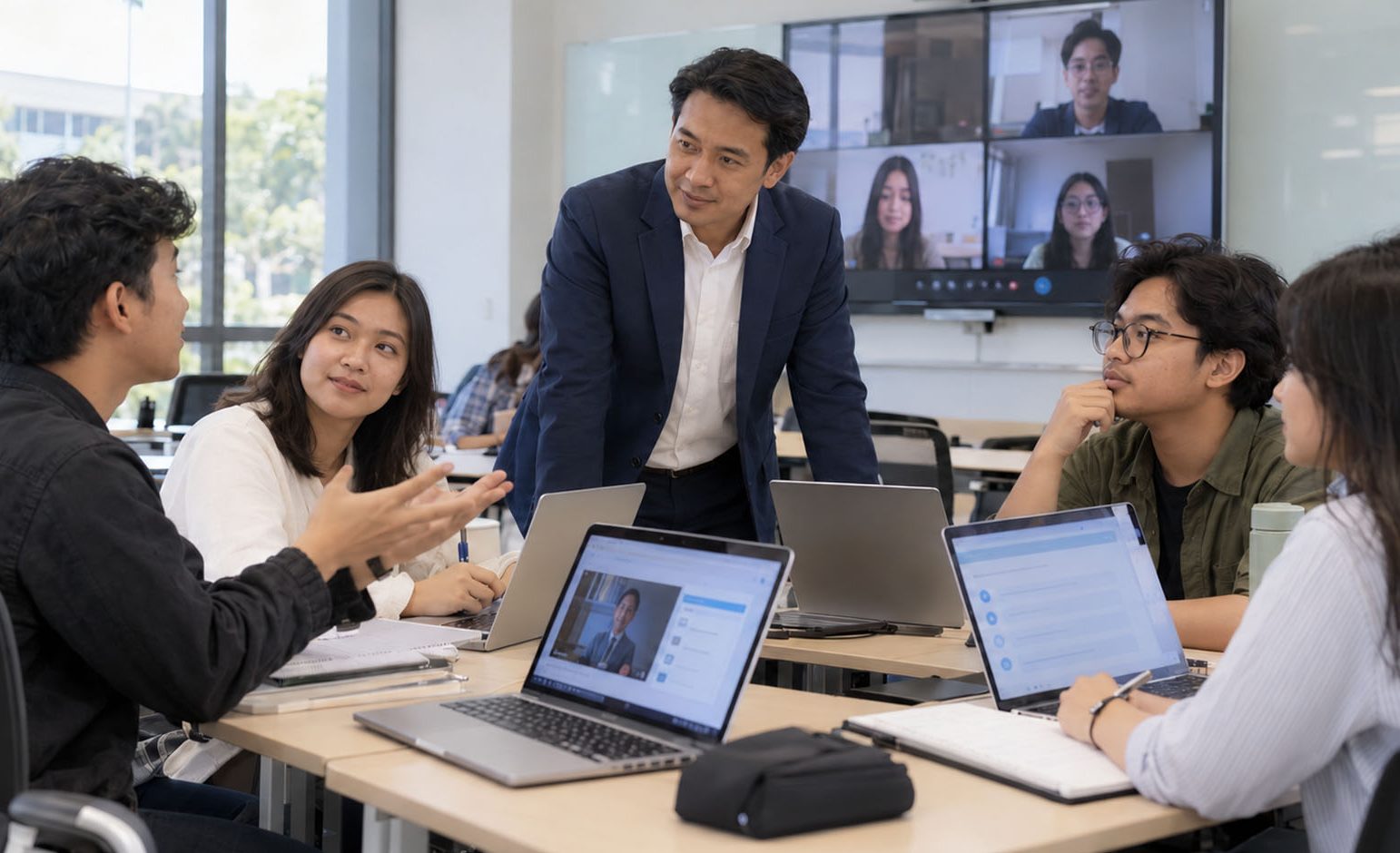
Does every learning activity need to happen in the classroom? Imagine students arriving in class having watched a short video, read a case study, and answered guiding questions in Moodle. Their responses provide a starting point for discussion, allowing the lecturer to focus class time on exploring ideas, solving problems, and deepening understanding. After the session, students return to Moodle to apply what they have learned and reflect on their progress. Each stage builds on the previous one, connecting independent preparation, guided learning, and structured follow-up into a meaningful learning journey. Learning unfolds across different spaces and times, guided by a clear purpose. This connected experience lies at the heart of flexible learning through M-Flex.
Design a Connected Learning Journey
UPH developed M-Flex to provide flexibility in the learning process while encouraging significant learning. Blended learning is one approach that supports this goal (Katoppo et al., 2023). It integrates face-to-face and online learning experiences through intentional design, creating opportunities for more interactive and student-centered learning (Garrison & Kanuka, 2004; Graham, 2006).
The key is how these experiences connect. Materials in Moodle should prepare students for guided activities, while follow-up assignments should help them strengthen and apply their understanding. Each activity contributes to the same learning outcomes.
Start by asking: “What do students need to do to achieve the course learning outcomes (CPMK)?” The answer helps determine the activities, evidence of achievement, and learning modalities that best support those outcomes. UPH’s digital learning ecosystem provides complementary tools for this process. Moodle serves as the central space for materials, instructions, activities, and assessments. Microsoft Teams supports live online meetings and interaction, while Panopto provides access to learning videos and recordings through Learn UPH (Universitas Pelita Harapan, 2025). Choosing each platform according to its purpose helps students follow a clear learning pathway. A practical way to organize this pathway is to connect three stages:
- Before the Session:
Build readiness. Students prepare independently through readings, videos, interactive materials, guiding questions, or short quizzes. For example, they watch an introductory video, read a case study, and answer three questions in Moodle. The lecturer reviews their responses to identify concepts that need further attention. - During the Session:
Deepen understanding. Guided learning, whether onsite or online, focuses on activities that benefit from lecturer facilitation and interaction. Students might work in groups to analyze the case, compare solutions, explain their reasoning, and receive feedback. Their preparation becomes the starting point for discussion. - After the Session:
Apply and reflect. Structured follow-up activities help students consolidate their learning through assignments, exercises, quizzes, forums, or reflections. For example, students submit a recommended solution in Moodle and explain how the discussion changed or strengthened their initial position.
These stages should be reflected in the course learning plan (RPS), with clear connections to the CPMK, time allocation, and assessment. The sequence outlined in the RPS should be visible in Moodle and carried through into course sessions, helping students understand how each activity supports their progress throughout the course.
Keep Learning Flexible and Structured
Flexibility also means helping students continue learning when they cannot attend a session. Recordings allow students to revisit content and replay sections they need to understand more fully. Research on lecture capture discusses the benefits of flexible access and replay, including access to missed learning (Nordmann & MacKay, 2026). A recording becomes more useful when accompanied by clear guidance. For example, a lecturer can share a recording through Panopto, identify key sections, and connect it to a Moodle activity. Students then watch the relevant sections, answer comprehension questions, and submit a short reflection. This gives them a concrete pathway to continue following the learning sequence in the RPS.
The same principle applies to independent activities. Students need to know what to do, when to complete it, and how their work will be assessed. Research suggests that the relationship between learner control and engagement can vary across activity types (Wang et al., 2025). The flexibility offered should therefore reflect the purpose and design of the activity. Consider the difference between “read the material before class” and a more specific instruction: “Read Sections 2–3, identify two main causes of the problem in the case, and post your response in Moodle before the next session.” The second instruction gives students a clear focus and an expected output. Within this structure, lecturers can offer choices, such as when students access materials within a defined period or how they present an assignment. Clear goals, deadlines, and assessment criteria help students use those choices purposefully.
M-Flex Quick Check
Before implementing blended learning, review your design using these questions:
Start with one course topic. Identify what students need to prepare, what they would benefit from doing with the lecturer, and what they should complete afterward. Connect these activities in the RPS and Moodle so that students can follow the learning journey with confidence. When each stage has a clear purpose and builds on the previous one, flexibility can expand opportunities for learning while keeping students focused on the outcomes.
Design the learning first. Choose the modality second.
Katoppo, M. L., Angraini, L., Valencia, P., Rahardjo, Y., Wibisono, A., & Sommers, C. L. (2023). Rethinking learning & teaching, the blended ways: New
classroom design for Universitas Pelita Harapan. International Conference of Social Design 2022 Proceeding, 1, 166–172.
Nordmann, E., & MacKay, J. R. D. (2026). Lecture capture as Universal Design for Learning: A post-pandemic scoping review. Current Opinion in Physiology,
47, 100896. https://doi.org/10.1016/j.cophys.2025.100896
Universitas Pelita Harapan. (2025). UPH Student Handbook 2025–2026. Universitas Pelita Harapan.
Wang, L., de Vetten, A., Admiraal, W., & van der Rijst, R. (2025). Relationship between perceived learner control and student engagement in various study
activities in a blended course in higher education. Education and Information Technologies, 30, 2463–2484. https://doi.org/10.1007/s10639-024-12910-w
D.Randy Garrison; Heather Kanuka. (2004). Blended learning: Uncovering its transformative potential in higher education. , 7(2), 95–105.
https://doi.org/10.1016/j.iheduc.2004.02.001
Graham, C. R. (2006). Blended learning systems: Definition, current trends, and future directions. Dalam C. J. Bonk & C. R. Graham (Eds.), Handbook of
blended learning: Global perspectives, local designs (pp. 3–21). Pfeiffer Publishing.