Outcome-Based Education (OBE)
Implementation Guidelines
Outcome Based Education (OBE) emphasizes constructive alignment to ensure that students achieve the intended learning outcomes. This alignment starts with the formulation of the Graduate Profile, which is translated into Program Learning Outcomes (CPL). The CPLs are subsequently mapped to Course Learning Outcomes (CPMK) and evaluated through aligned assessment strategies. To support consistent curriculum documentation and streamline academic administration and reporting processes, Universitas Pelita Harapan (UPH) has implemented an OBE based Curriculum Management System integrated with the Oracle People Campus Solution (OPCS).
Assessment
Weight Mapping
Before entering data into the OPCS Curriculum Management System, study programs and course lecturers must first determine the assessment weight for each learning outcome using the Microsoft Excel template. Access the template here. Assessment weight mapping is a critical step because it:
The percentage weight of CLOs toward PLOs must consider the taxonomic levels within each domain (knowledge, attitudes, and skills) integrated into the CLOs, as well as the student learning workload allocated to achieve those specific outcomes.
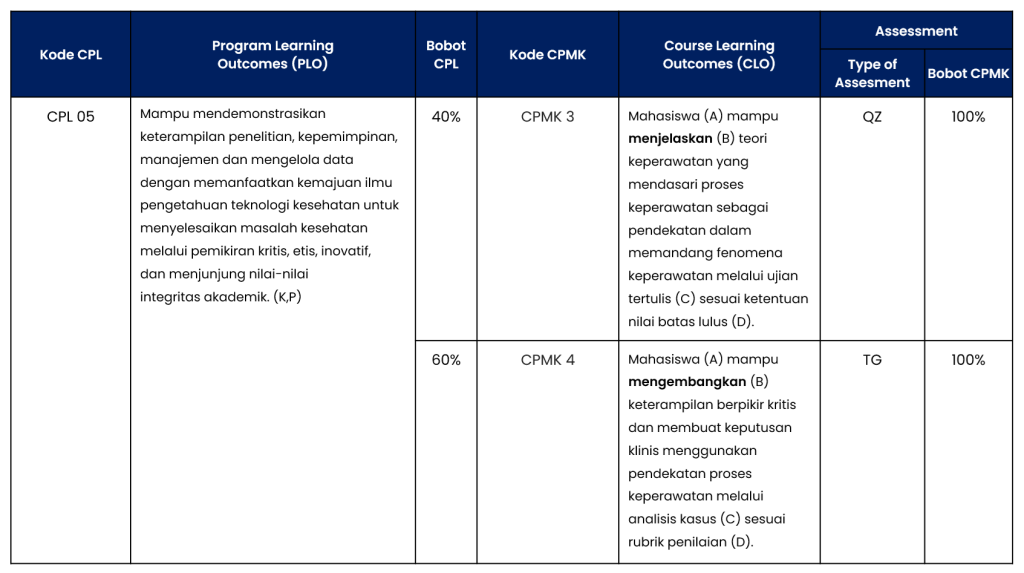
Example: In a specific course, a Program Learning Outcome (PLO 05) is translated into two Course Learning Outcomes, namely CLO 3 and CLO 4. Based on these data, the PLO weight contribution for CLO 3 is lower (40%) compared to CLO 4 (60%). This difference in weighting is based on the depth of the learning objectives. Kata Kerja Operasional (KKO) for CLO 3 is positioned at a lower taxonomic level (Lower-Order Thinking Skills), where students are expected to be able to explain nursing theories through a written quiz (QZ) as the evaluation instrument. Conversely, the PLO weight for CLO 4 is higher due to its more complex learning taxonomy requirements (Higher-Order-Thinking Skills), which demand that students demonstrate the ability to develop critical thinking skills and make clinical decisions through case analysis (TG).
The weighting of the Assessment Category against the CPMK serves to validly measure the proportion of an assessment instrument (whether PAR, PRO, QZ, TG, UTS, or UAS) in evaluating the attainment of the related CPMK.
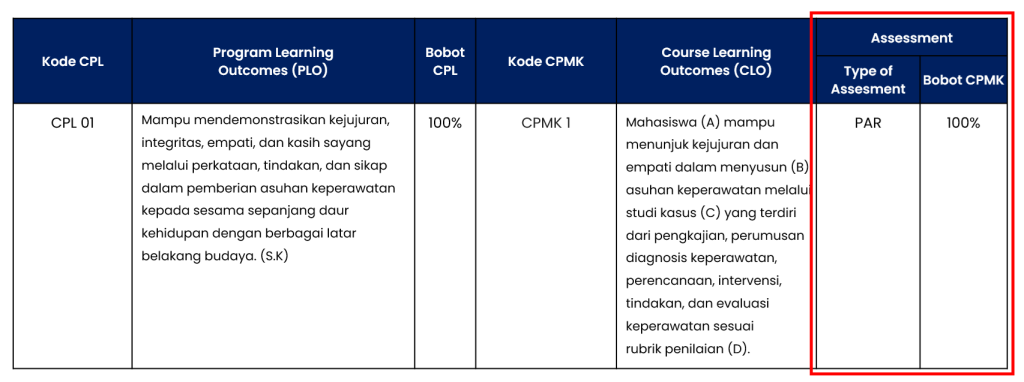
Example: In this course, a Program Learning Outcome (PLO 01) is fully translated (100%) into a single Course Learning Outcome, namely CLO 1. Through CLO 1, students are expected to demonstrate honesty and empathy in developing (B) nursing care plans. This process is evaluated through the case study method (C), which encompasses the stages from assessment to nursing evaluation, aligned with the assessment type specified in the table, namely participation (Type of Assessment: PAR).
For course learning achievement data to be successfully saved within the OPCS system, the total weight for a single CPL (CPL Weight) mapped to CPMKs must equal 100%, and the total assessment category weight (Category Weight) for a single CPMK must also reach exactly 100%.
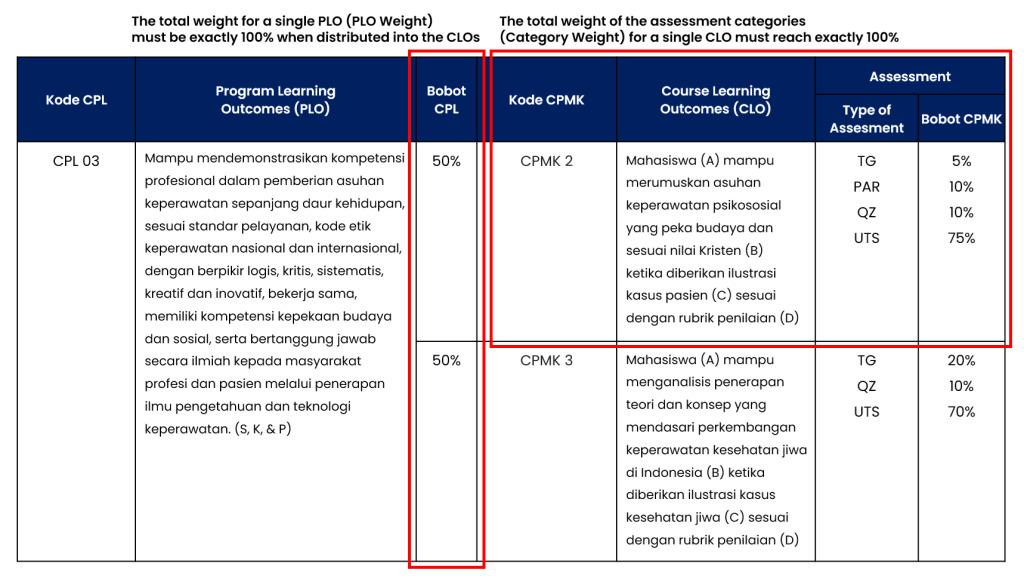
Example: In this course, a Program Learning Outcome (PLO 03) is equally distributed (50% each) into two Course Learning Outcomes, namely CLO 02 and CLO 03. For CLO 02, students are expected to formulate culturally sensitive psychosocial nursing care plans aligned with Christian values (B) through patient case illustrations (C). The attainment of CLO 02 is evaluated using multi-instrument assessments, which include Assignment (TG: 5%), Participation (PAR: 10%), Quiz (QZ: 10%), and Midterm Examination (UTS: 75%).
Meanwhile, for CLO 03, the learning taxonomy domain is positioned at a higher level, requiring students to analyze the application of theories and developmental concepts in mental health nursing (B) through relevant case illustrations (C). The evaluation of CLO 03 is measured through Assignment (TG: 20%), Quiz (QZ: 10%), and Midterm Examination (UTS: 70%).
Learning Outcomes Monitoring and Evaluation Flow (PPEPP Cycle)
The measurement of curriculum attainment at UPH follows the PPEPP cycle (Establishment, Implementation, Evaluation, Control, and Improvement) to support Continuous Quality Improvement (CQI).
- Evaluation Phase (Monitoring and Analysis):
Student learning outcome data from completed academic periods are retrieved from the Learning Outcomes module in OPCS and visualized through the Power BI Dashboard. Subsequently, lecturers and study programs conduct a Management Review Meeting (Root Cause Analysis) to evaluate the results and address the key question: “Have the CPMKs been achieved according to the established targets?”
- Control Phase – Corrective Action (If NOT ACHIEVED / Score < Target):
This phase focuses on addressing gaps in learning outcome attainment identified during the evaluation process. The faculty team performs a root cause analysis by examining assessment items, teaching methods, and learning media, and subsequently revises the RPS/Syllabus, teaching materials, or assessment strategies. These corrective actions are then implemented in the following semester.
- Improvement Phase – Continuous Development (If ACHIEVED / EXCEEDED):
When the targeted learning outcomes have been achieved or exceeded, the study program proceeds with continuous improvement initiatives, including benchmarking and tracer studies. The findings are documented in a Curriculum Addendum, which may include revisions to CPL descriptions and restructuring of the course map, and are incorporated into the latest curriculum as the new CPL standard.
Strategic Role of CPL–CPMK Monitoring in Study Program Accreditation
The monitoring and evaluation of learning outcomes play a strategic role in supporting study program accreditation at both the national (BAN-PT and LAM) and international levels while promoting continuous quality improvement.
- Authentic Evidence of Continuous Quality Improvement (CQI):
Modern accreditation frameworks place significant emphasis on Outcome-Based Education (OBE) and continuous quality improvement. The documented audit trail, from the evaluation phase through corrective actions and curriculum improvements (Curriculum Addendum), provides authentic evidence that the Internal Quality Assurance System (SPMI) is effectively implemented and continuously maintained within the study program.
- Readiness of Self-Evaluation Report (LED) Data:
Through an integrated reporting system powered by Power BI, study programs no longer need to manually compile learning outcome data during the accreditation process. Valid and reliable statistics on CPL attainment, from the study program level down to individual student performance, are readily available and can be accessed for audit purposes at any time.
- Public Accountability:
Transparent reporting and visualization of learning outcome achievement demonstrate that the study program’s curriculum effectively develops graduates who meet the intended Graduate Profile, thereby strengthening institutional accountability to stakeholders.
Reading the Power BI Dashboard Visualization
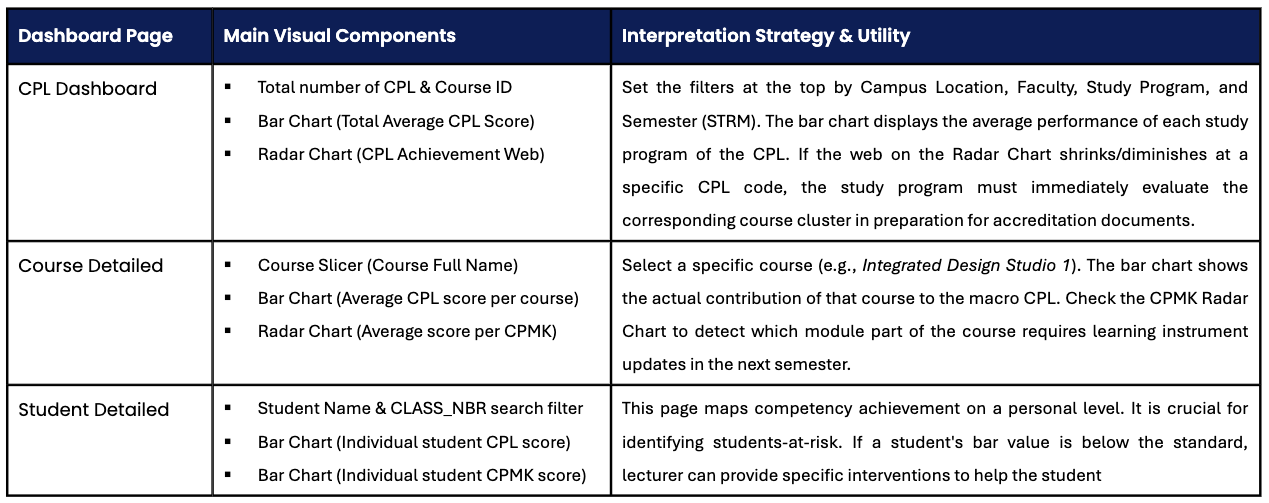
Once the Heads of Study Programs (Kaprodi) assisted by the administrative staff, have completed mapping the PLOs onto the CLOs and entered the data into the OPCS system, faculty members in each study program can analyze the supporting data for accreditation and quality evaluation. This can be accessed via the learning outcome dashboard on the portal.uph.edu platform by navigating to the Dashboard column > selecting the CTL unit from the Dashboard menu > selecting “Dashboard Evaluasi Capaian Pembelajaran” (accessible only to Deans and/or Heads of Study Programs). You may utilize the three main pages on the Power BI Dashboard using the following interpretation methods:
Note:
- Visual reporting on the Power BI dashboard will only become available after the grade input period in OPCS is officially closed. Therefore, the process of inputting learning achievement data and assessment weights for new Course IDs in that term MUST be completed by the study program at least 2 weeks before the final exam (UAS) period begins.
- The learning outcome dashboard on portal.uph.edu can only be accessed by the Dean and/or the Head of the Study Program.
Guidance & Technical Assistance
To support the implementation process, we provide a comprehensive guide and practical examples for mapping CPL to CPMK, along with step by step instructions for entering the data into the OPCS system. Click here to access the implementation guide.
If you need assistance with completing the Excel alignment template (CPL–CPMK mapping) or experience any technical issues while entering data into the OPCS system, please contact the UPH Center for Teaching and Learning (edu.tech@uph.edu) team for support.